28 April 2023

Pesto Made with Carrot Tops

Don't throw out leafy green carrot tops. Use them to make a tasty pesto sauce perfect for topping pasta or as a dip.

An abundant carrot harvest this year has given me a lot of carrot tops. I've thrown them away in the past, always wondering if there was something I use them for.

There is! Carrot tops are edible; you could add them to a salad if you wanted. 

Woman holds a bunch of green carrot tops in front of her with words Pesto Made with Carrot Tops to the left and road to self reliance dot com in the lower right.

What I prefer to do is use them to make pesto. I make a big batch and freeze so I can have pesto to eat all year.

Pesto is traditionally made with basil, and if you have fresh basil, you can use it along with the carrot tops. The first time I made it, I did a mix of the two, but in Florida the seasons for carrots and basil don't overlap much.

Ingredients for Carrot Top Pesto

  • Carrot Tops (and basil if you prefer)
  • 1/2 cup Nuts for each cup of carrot tops (Pinenuts are traditional for pesto, but I use less expensive walnuts. Pecans are also good. If you have an abundance of a nut, try it.)
  • Salt to taste
  • Garlic to taste (a clove can be chopped up with everything else; fresh garlic bothers my stomach, so I use garlic powder)
  • Lemon juice to taste
  • 1/4 cup Olive Oil for each cup of carrot tops
  • Hard cheese such as Parmesean or romano to taste

To Make the Pesto

  1. Remove the leafy parts of the carrot tops from the larger stems. Wash and drain. Pat dry to remove as much water as possible.
  2. Put nuts in the bowl of a large food processor and pulse to chop up. Add in as many of the carrot tops as will fit, then pulse to break up. Scrape the bowl of the processor, and add more carrot tops. Pulse several times. If using fresh garlic, add it now.
  3. Once everything is finely chopped, add the salt, lemon juice, and garlic powder (if not using fresh garlic).
  4. Turn the processor on high and let it run. Through the tube, slowly add the olive oil, a few tablespoons at a time. Check the consistency and add more oil. Scrape down sides of bowl as needed. 
  5. Continue processing, adding oil a few tablespoons at a time, until reaching desired consistency.
  6. If you are going to eat the pesto immediately, add the cheese now, and process to distribute it. Serve over warm pasta. If you are going to freeze the pesto for later use, do not add cheese, and follow steps below.

To Freeze the Pesto

  1. I use an old ice cube tray, and fill each compartment with the pesto. 
  2. Place it in the freezer until frozen, several hours or overnight. 
  3. To remove from tray, run a dull knife (such as a table knife) around the edge of each cube to help release it, and store in a freezer bag until needed.

To Use Frozen Pesto

  1. When ready to use, pull out the number of cubes needed. (I find 3-4 work good for one serving). 
  2. Put in a pan over low heat. 
  3. As they thaw, stir and add more olive oil if needed. 
  4. When heated through, stir in grated hard cheese of your choice. Serve over warm pasta, or use as a dip.
Click below to watch the video of me making pesto with carrot tops.

Want More Ideas for Cooking with Scraps?

Don't throw out what you can use! You can find more recipes and ideas in the Cooking with Scraps label.

07 April 2023

Grow Your Own Sprouts and Always Have Fresh Greens

Sprouts are easy to grow on your kitchen countertop and can be ready in less than a week. Here’s how I do it.

Do you live in a climate where it is hard to grow lettuce? For me, in zone 9b in Florida, I can grow lettuce in the late fall and through winter, but the rest of the year, it is too hot.

Yet I want fresh greens to put on sandwiches and add to salads. I also want to produce more of my food and rely less on grocery stores.

I have found growing sprouts on my kitchen counter to be a great alternative. They are quick to produce, require little space, and are cost. 

This post contains affiliate links. This means if you make a purchase, I may receive a small amount of compensation at no additional cost to you.

Watch Video

Here's the video of my process for sprouting seeds. Supplies and instructions are below.


Supplies:

  1. Sprouting Seeds (I've purchased from Sprout People and from Mountain Rose Herbs with great results)
  2. Glass jar - I use a pint size
  3. Cover for the jar that lets you drain water – you can use cheesecloth and rubber band it around the top, which is what I did initially. However, it is messy, and the cheesecloth quickly wears out. I purchased a set of three from Sprout People and have found them to be a great help. You can easily change the screen from the smallest to larger holes to let the water drain effectively as the sprouts grow

To Sprout:

Put 1 tablespoon of sprouting seeds in the jar. If you have a larger jar, you can use more seeds and make more sprouts; however, be sure you will use them all before they go bad – mine last about 10 to 12 days in the refrigerator.

Cover seeds with plenty of water. You want to be sure they get completely wet.

Stir to be sure all seeds are wet.

Cover with a lid that will let you drain and let sit in a darker place on a counter for 8-12 hours. Different seeds have different soak times, so check the package or do an internet search for optimal soak times. I like to start mine in the evening and let them soak overnight.

Drain off the water. You may want to turn it upside down on a dish drainer to let the most of the water drain out.

Set the sprouts on the counter out of direct light.

About every 12 hours, add water to the jar and swirl it around to be sure all seeds are wet. Drain.

Continue with this until most of the seeds have sprouted and filled the jar. This will vary depending on the type of seed and the temperature of your home. Mine are ready a day or so earlier in summer than winter.

Remove from the jar and put in a container in the refrigerator.

How to Use Sprouts

  1. Put them on sandwiches. When it is too hot to grow lettuce, these are a great replacement. 
  2. Add them to salads.
  3. Mixed them into egg salad for a bit of crunch and flavor.
  4. Eat them out of hand as a snack.

10 January 2023

Setting Up My First GreenStalk Garden

Interested in a GreenStalk Garden? Here is how I set up and what I planted in my first GreenStalk.

A GreenStalk Garden can be a great way to increase your growing area even in a small space. My garden is on my patio, and while I've expanded to include a couple of raised beds, a GreenStalk lets me add more.

You can watch the video of the entire set-up, or read below for how I set mine up.


Setting up your GreenStalk is easy, but there are a few tips I learned while setting mine up.

This article contains affiliate links. That means if you click the link and make a purchase, I may receive compensation at no additional cost to you.

Included with your GreenStalk are instructions. They are not complicated, but be sure and read through them carefully.

How to Set Up Your GreenStalk Garden

After unboxing your GreenStalk, be sure you place it on a firm and level area. This was a mistake I made. The area I put it in is filled with lava rock. I leveled the rock as much as I could, then placed a concrete paver on it. It seemed sturdy and level, but when I put the base on it, I found it wasn't. First, the paver wasn't large enough for the entire base to sit on, and second, it wasn't level.


My husband realized the problem and took out the lava rocks, put down two pavers, and firmly tamped it in place. (Thanks, honey!!) When I set the base on it, I realized how much better it was.


The GreenStalk doesn't come with a base, and you do not need one. There are three bases to choose from: a spinner, a roller, and a spinner with rollers. I knew I needed to be able to spin my around making it easier to tend to in limited space, and so all sides can get some sun during the winter. I wasn't going to be able to roll mine, so didn't need that type of base. Think about where you are going to put yours and decide what you need.

If you have a base, a drainage tube will be included in your box. Go ahead and put that in, then set the base in place. 


Assemble the GreenStalk Garden Tiers

To assemble the GreenStalk, take one tier and put it on the base if you have one. Fill with potting soil. As the instructions say, fill it completely. When you think it is full, add some more. 

Then take one of the grey disks and place it on top of the tier. The disks are the water reservoir for each level, and small holes are near the edge to drip the water into the soil below. Line the holes up with each pocket of the tier. 


Get another tier and put it on top of the first one. NOTE: Be sure the tier locks into place with the one below. It may not completely lock into place until you fill it with soil, so be sure and check after you fill it.

Fill with soil and place the grey disk. Be sure everything is lined up properly, then add the next tier.


Repeat until all tiers are in place, then place the reservoir on top, again locking it in place with the tier below.

Pour water into the top reservoir. Continue adding until it runs out of the drainage tube.

Your Greenstalk Garden is now ready to plant.


Two reminders: 

  1. Be sure your GreenStalk is set on a firm and level area 
  2. Make sure each tier locks in place.

Get Your Own GreenStalk Garden

Interested in your own GreenStalk? If you go to GreenStalk Gardens through this link, you will get $10 off your order of at least $75. 

Happy growing!


02 January 2023

Cut Up Old Clothes for Rags

Don't throw out old clothes that can no longer be worn. Repurpose them into rags that can be used a variety of ways.

I try to wear things as long as I can. I mend tears and remove or cover stains. I make alterations or turn them into something else. But the day will come when they are just too far gone to be wearable, even for dirty chores.

You may be tempted to throw them out, but don't! There is one more thing you can do with them - cut them up and use them as rags. Use them to wipe up messy spills, to wipe dirty hands, and to clean with.

Here is how I cut up an old sleeveless t-shirt and an old pair of shorts.

*Bonus - be sure and save any trim and fastenings you can. If there are buttons or metal zippers, cut them out and save with your sewing supplies.

Cut Up an Old T Shirt

Before cutting, decide how large you want your pieces to be. Maybe you want a really large piece and cut down one side to open it up. Maybe, like me, you like smaller pieces, so you cut more. 

Watch the video to see how I cut up one shirt (and see how I can repurpose the banding around the neckline and sleeves).


Cup Up Old Shorts

This also works for jeans or trousers, as well as shorts. Decide how large you want your rags to be before you begin cutting.

Remove any fastenings or trim you want to keep. Buttons and metal zippers can be reused on another sewing project.

This video shows you how I did mine.

Using The Rags

Anytime you think of reaching for a paper towel, consider if one of your rags would work. I keep a large stack in the kitchen for wiping up spills, and I find them a great way to clean grease and oil from cast iron pans. When the rags get dirty, they are easy to wash and reuse until they completely fall apart.

03 December 2022

Orange Peel Tea - Cooking With Scraps

Don't throw out orange peels. Chop them up and make a tea that is filled with Vitamin C and is thought to be good for your digestion.

When you peel an orange, what happens to the peel? Maybe you make orange marmalade or candied orange peel, but how much of those do you use?

Perhaps you put the in your compost pile. That is great, but I have something you can do with them before composting.

Make orange peel tea.

Easy to do and requires little hands-on time.

There is more vitamin C in orange peel than the fruit. The tea is also thought to benefit your digestive system.

You can also use tangerine/mandarin orange peel.

Here's how I do it.


To make orange peel tea:

  1. Chop orange peel into 1/4 inch pieces. You can use fresh peel or dried.
  2. Put peel in a pan. For each 2 tablespoons of fresh / 1 tablespoon of dried peel, add 1 cup water.
  3. Bring to a boil, then turn off heat.
  4. Let steep one hour.
  5. Strain out peel.
  6. Drink warm or at room temperature.
  7. You can refrigerate the leftovers for a few days, or freeze for later use.
Enjoy!

19 November 2022

Fall 2022 Seed Order

I placed seed orders with four different seed companies. Here's what I received.

November may seem an odd time to talk about new seeds, but where I garden, zone 9b on the Atlantic coast of Florida, we are in a cooler season to grow things others grow during the summer.

For this order, I have some herbs and vegetables I'll plant now, and others that I will start as we near our last average frost date in February.

Even if you won't be able to plant for months, it is always fun to look through seeds and think about what you want to plant when you can. 

Watch the video below to see what I received.


The seed companies I ordered from were:

Baker Creek

Botanical Interests

Seed Savers

Working Food


31 October 2022

Shrimp and Spaghetti - Quick and Easy Recipe

This shrimp and spaghetti meal is quick and easy to pull together. With only a handful of ingredients, you can have it ready to go in no time.

Last week my husband and I were trying to come up with something to have for dinner. We both wanted something "different", meaning, we hadn't eaten it in the last week or so. We each made suggestions when he said "why not do the shrimp and spaghetti thing you do with the Italian dressing."

Sounded good to me, and we were soon eating and enjoying it.

Note: I don't measure when I prepare this, so my amounts are estimates. If you are using leftovers, take what you have and go from there. Experiment and play around with it.

Ingredients

  • Shrimp - I used frozen, raw shrimp; you can also use cook shrimp and this would be a great way to use up leftover shrimp
  • Spaghetti or other pasta your family enjoys - if you have leftover pasta, start with that!
  • Green onion, chopped - regular onion bothers both our stomachs, but green onion makes a good substitute for us
  • Bottled Italian salad dressing - I have never found a homemade version I like better, but if you have one, please send it to me!
  • Butter or oil to cook the shrimp in
  • Salt and pepper
  • Garlic powder (again, garlic bothers both our stomachs, but garlic powder does not so we use it instead)

Instructions

Metal pan on stove with a glass lid. Inside the pan, water is boiling.

Put the water on to boil to cook the spaghetti. 

Cast iron pay with shrimp cooking in butter with a wood spoon for stirring.

Melt butter in a cast iron skillet then add shrimp. Season with pepper and garlic and cook.

Metal pan on stove. There is water and spaghetti noodles in the pan, and a pasta spoon laying next to the pan.

When water comes to a boil, add salt and return to a boil. Add pasta and stir in well so it cooks evenly. 

When shrimp are almost done, stir in the green onion and cook them.

When pasta is cooked, drain well and return to pan. Stir in the shrimp, then pour in some Italian dressing. Do NOT add too much to begin with - add some, stir in well, then add more if needed.

Bowl filled with spaghetti and shrimp on a counter. A pair of glasses in in the upper left corner and a drinking glass in the upper right.

Spoon onto a plate or bowl and top with freshly grated parmesan cheese if desired.

Serving note - I often serve peas or green beans with this, and I usually just mix them in with the pasta, coating the vegetable with the dressing as well. This would be another way to use up leftover vegetables.

Try It Yourself

That's all there is to it! If you have already cooked food, you only need a few minutes to warm things up and put them on a plate. If you cook everything from scratch, as I did, within 45 minutes you can be eating a homecooked meal. 

Give it a try and let me know what you think.

17 October 2022

Hurricane Ian Preparation and Aftermath on the Beachside Homestead

Living a block from the Atlantic Ocean in Florida, we are familiar with preparing for a hurricane. Here is what our urban homestead did to prepare for Hurricane Ian, and what we dealt with after.

In the nine years I've lived in Florida, I have been through several hurricanes and tropical storms. Thanks to my husband, who has lived here longer, we have a good plan to prepare for hurricanes. No plan is perfect; however, it is better than having nothing.

When we were first put in the "cone of uncertainty" by the National Weather Service, I began preparing by printing off my Hurricane Preparation Checklist. (Click to learn how I made mine and do one for your unique needs.)

Then I began pulling out things I needed: flashlights and batteries, candles and lighters, rain gear, and towels to soak up any water that came in. I emptied much of the ice from my ice maker, putting it in bags in the freezer. This has a dual purpose. If we lose power, the ice helps things in the freezer stay frozen longer. If we don't have water, we can melt the ice and use it to drink and cook with.

The garden has to wait until the last minute, so the plants get as much sunlight as possible. Some go into the garage while others are moved to a corner on the patio. The good thing about a container garden is most of the plants are easy to move.

We tied down the awning over the front door, and staked a tied a few of our decorative bushes and fruit trees. Most of the fruit trees I have grown from seed and don't want to lose them.

By the time the rain arrived on Wednesday, we were finished and safely inside.

Watch the video that shows some of the prep work and also the aftermath of Hurricane Ian on our home.

21 September 2022

Protect Your Summer Garden with an Inexpensive DIY Sun Shade

During the heat of summer, a sun shade may protect your garden plants. Here's an inexpensive DIY version that I tried.

Living in gardening zone 9b, I've learned that July and August are not good for growing crops. Even heat loving vegetables can slow or stop producing as the sun that beats down on them daily. No amount of watering can compensate for the brutal sun. 

Shade, however, can offer some relief. Please understand that this won't let you grow crops that northern friends grow with ease during the summer. What it can do is help keep plants alive and prevent damage to produce.

My Garden Needed Relief From The Sun

The off-season for gardening in Florida is the heat of the summer. July and August are not good times to grow things. Plants that produced well during the spring may still be alive, but production is diminished.

My garden is on the patio between my house and garage. It is south facing, and enclosed with a privacy fence and the concrete walls of the garage and house. During the summer, it gets hot in that area.

This year I noticed that my bell peppers, which normally love the summer sun and heat, were getting sunscald. I needed to do something.

One solution is to put up sun shade. The idea intrigued me, but I didn't want to spend a lot of money until I could tell if it helped or not. When I found this article, I knew I had a place to start.

My Sun Shades

I purchased several yards of nylon netting, cut it to (more-or-less) fit over the raised beds, and tied the corners to bamboo sticks inserted in the beds. 

Fenced in area containing raised beds and container plants. Over the raised beds are pieces of nylon net tied to bamboo poles inserted into the raised beds.


Pros

  • It was inexpensive
  • It was easy to set up
  • It was easy to take down when summer storms blow through

Close up of the nylon net tied to a bamboo pole placed in the raised bed.


Cons

  • It didn't cover the entire bed. I will need to get longer bamboo poles and put them in the ground outside the bed for better coverage.
  • It wasn't enough to protect all my plants - my green beans shriveled and died even with the sun shade (to be fair, I planted them much too late so they probably wouldn't have made it anyway)
  • It isn't the prettiest look (although my garden is behind fencing, so only my husband and I see it.

Raised garden bed with nylon mesh over it, held up by bamboo poles.


Overall Impression of my DIY Sun Shades

For taller plants, like my everglades tomato, I need taller poles. This also means that other things may not get enough protection, but careful planning of where I plant in the raised beds could mitigate that.

For other containers, I'm going to have to come up with a way to cover them. 

Will I Use Them Again?

Absolutely! My bell peppers, while still small due to the heat, did not have any more sun scald. 

I plan to buy more nylon netting and cut it to better fit over my raised beds. What I used this year can be cut down to place on container plants. 

I was late putting it up this year - mid-July - and want to try it earlier next summer.

If you notice sun damage on plants in your garden, give this easy and inexpensive DIY sun shade a try and see how it works for you.


02 July 2022

Tour of Zone 9b Urban Garden June 2022

A garden update for June 2022. I live in Zone 9b, Florida, have an urban, container garden.

The garden is going well this year. After taking out the hot tub and putting two raised beds in the space, there is a lot more room to grow things this year.

Which is good because my husband made a trip to Home Depot in March and came back with six bell pepper plants and six tomato plants of different varieties! The peppers went in one of the beds, while I continue to put tomatoes in smaller containers so they can be moved around. They don't do well under the worst of the Florida sun and I try to find places with a bit of shade for them.

Here's what the garden looks like in June 2022.

 
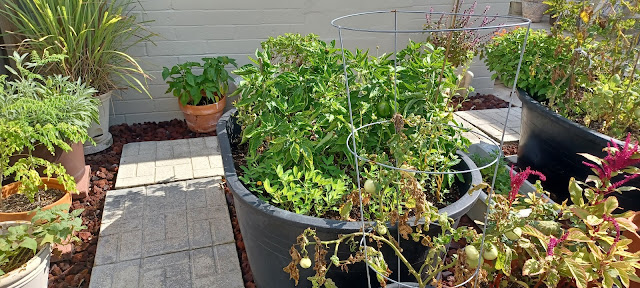
You can see much of the garden in this photo. In the raised bed nearest the camera, the flowering plant hanging over is a penta. There were two of them and they outgrew the space, so I moved one to the other raised bed.
 
In the tomato cage are a couple of everglades tomatoes. You may not be familiar with that variety. They are very small - smaller than a cherry tomato - but they do well in the Florida heat and humidity. I planted the seeds last fall, but they didn't germinate until earlier this year. I often pick 6-8 a day and find them a fun snack or addition to a salad.
 
There is also some celery in there. I planted it last fall and it did not do much, and I am shocked it has not completely died in the heat. Hasn't gotten big enough to really do anything with other than add flavor to cooked dishes, but I still have seeds and will try again this fall.
 
At the far end green beans trying to grow. I've had pretty good luck growing them in containers, but the ones I planted earlier this year in the raised bed did not do well. I realized that in this size raised bed, they need more water. That has helped, but I believe I need to get some shade cloth for them as well.  

The container with the blooming flowers next to the wall is Purple Opal Basil. I received the seeds free with an order from Baker Creek in 2020 and have been thrilled how well it grows here.


On the other side are containers with bell peppers I grew from seed, turmeric, amaranth with some of the tomatoes my husband bought, and a couple of the hanging baskets that were on the ground for a good watering.

Between the beds is a container with New Zealand spinach. This is not a true spinach, but a green that does grow well in my climate. I try to sow seeds every month or so to enjoy these in salads and on sandwiches. You can't tell, but there are also three loquat trees in there. I sprouted the seeds this spring, and am going to move them to larger containers.

Loquat is also known as Japanese Plum. The fruit is smaller than most plums, and has several large seeds in it. It blooms in January and the fruit is ready to pick in February and March.

I sprouted a seed about five years ago. That tree is over five feet tall and I am looking for a place to plant it in our yard.


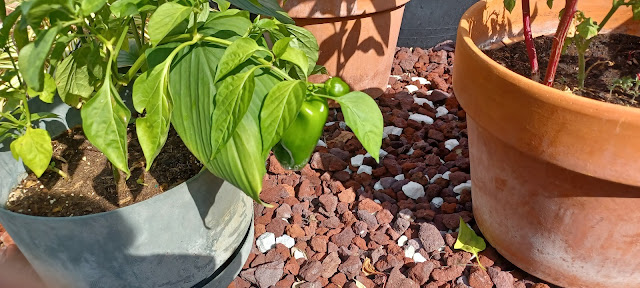
Close up of a bell pepper on one of the plants I grew from seed.
 

The other raised bed is where I planted the six pepper plants my husband bought. They have done fantastic! The first peppers I harvested were from the plants I grew from seed, but these have surpassed them. We are about to the point of calling friends and asking if they want any, as well as freezing some. We made stuffed peppers last weekend using peppers we grew. Very satisfying.

I also grow purslane in that bed, another green I add to salads and put on sandwiches, as well as calendula and a few coreopsis that grew from seeds left from last year's plant.

And, I have peanuts growing in there! This wasn't what I had planned, but when neighbors put out peanuts for the squirrels, who then bury them in my garden, what can I do? If the peanut sprouts, I put it in the bed. I did this last year in a couple of small containers and actually grew peanuts. 

Wouldn't it be fun to make my own peanut butter from peanuts I grew?!?


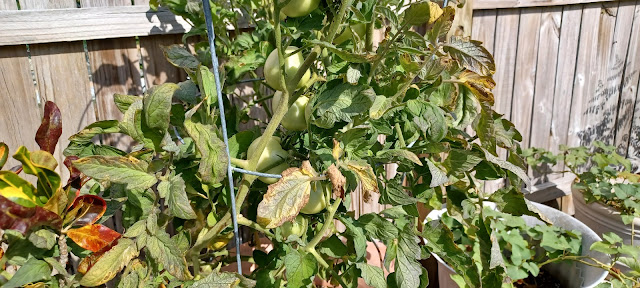
One of the tomato plants my husband bought. It has done really well, and there are 8-10 tomatoes on there. I have already harvested a few as they have begun to turn color. As you can tell from the leaves, it is getting stressed in the Florida summer sun. Once I pick the tomatoes on there, I'll pull the plant.
 
NOTE: When should you harvest tomatoes? I always thought you should leave them on the vine until they are red and fully ripe. As tomatoes began turning this year, I lost a number of them to some critter or critters who would peck a hole or take a bite. This was only in the containers that had cages on them, so I think they were using the cage to get to them. 
 
To get more of my harvest, I began to pick them as soon as they were obviously changing color and let them ripen in front of a window.
 
Then I came across this Reel on Instagram on the best time to pick tomatoes. Turns out, I was doing the right thing! 
 
Who knew vine-ripened was just a marketing ploy? 


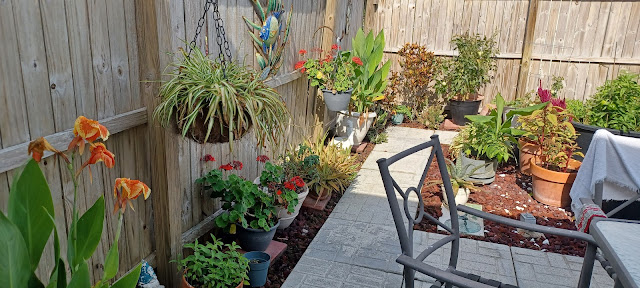
Along the west fence are (from the back) lemongrass, sage, moringa, and two containers with sweet potatoes.

Along this side of the fence are mainly ornamental and flowering plants - cannas, aloe vera, geraniums, and more hanging baskets of airplane plants.

Summer has definitely arrived here. In fact, it arrived in mid-May, which is early for us. So far, most things are hanging in there - the bell peppers thrive in this weather - but the next month will see the last of these tomato plants. Hopefully the green beans will come through. I'm going to buy some nylon netting to use as a shade cloth during the heat of the day. Once I set that up and see how it works, I'll have a post on that.

How is your garden growing this time of year?

Have you downloaded my free Plant Information Sheet? Print out as many copies as you need so you can record the growing, harvesting, and using information for everything you grow. Click here to learn more and get your copy.

02 June 2022

Cup Up Meat to Freeze

Buy meat on sale, cut into different pieces and freeze. An easy way to fill your freezer while learning a new skill.


This is a simple tip, but I want to share to encourage others to try it for themselves. I buy a pork roast on sale. I cut it in half. One half we cook in the crock-pot with vegetables. It gives us at least two meals.

Two pieces of uncooked port roast on a blue tray.


The other half, I cut into pork chops. 

Half of a pork roast left whole with other half cut into pork chops, all sitting on a blue tray.

Put in freezer bags and store in the freezer. I use vacuum bags so all the air is removed, helping prevent freezer burn. I haven't kept a record, but we usually eat things within a couple of months of freezing, and so far, have not had an issue with freezer burn.

Yes, we could buy pork chops on sale and freeze them. In fact, we did that for several years. But cutting our own lets us choose the thickness we prefer. 

This also works with other meat. Buy a whole chicken and cut it apart. Buy large cuts of pork or beef and divide up as you need them. This teaches you how to cut the meat apart, making your more self-reliant.

Don't wait until you are out to buy more. When you have some left, or the meat goes on sale again, repeat the process. This lets you gradually fill your freezer without a big hit to the budget.

08 October 2021

Vegetable Broth - Cooking With Scraps

Instead of throwing out vegetable scraps, leftover vegetables, and other bits and pieces, turn them into a broth to use in your cooking. 

This practice has several benefits. You save money. You produce less that needs to be thrown out. And you know where your food has come from.

Vegetable Broth from Scraps

Watch the video then scroll down for more detailed instructions.


Please note - this article may contain affiliate links. If you click through and make a purchase, I will receive a small compensation at no additional cost to you.

What to Save

Whenever you peel a potato or carrot, when you cut the ends off celery or squash or snap the ends off beans or peas, you probably throw that away. I did for years. Somewhere in my mind, however, I thought there must be a way to use these cast-off bits.


Saving Vegetable Scraps

Image of smiling woman holding a clear plastic bag filled with vegetable scraps.


One way is to save them in the freezer. When you fill a bag or two, you have enough to make the broth. How much you need depends on what size pot you have and how much space you have to store the broth.


Making the Broth

Stockpot with frozen vegetables in it sits on a stovetop.


Dump saved vegetable scraps into a pot large enough to hold the vegetables and water. Cover and turn to low-to-medium heat. As vegetables begin to thaw, use a spoon to break them apart. Once they are broken apart, add water until about halfway up the side of the pot. 

Silver metal stockpot with lid sits on a stovetop.


Cover and let simmer about 45 minutes. 

Vegetable scraps simmering in a large metal stockpot.


It will look something like this when it is done.

Strain the Broth

Woman holds a metal strainer over a pot as the broth drains into it.


Now it is time to strain the broth. I begin with a large strainer to get the pieces of vegetables and peels. Then I pour it through a finer strainer to catch more bits and pieces.  

The broth in a white bowl with handle.


The broth is now ready to use just as you would any broth you bought. I like to use it to season rice and to make mushroom gravy to serve with pork chops.

Saving the Broth

If you save a bag or two of vegetable scraps, you will get a lot of broth when you make it. To save it, you could can it or you can freeze it, which I prefer.  It is easy to pull out and thaw whenever I need some.

Woman pours broth into a blue freezer tray.


I like to freeze mine in an ice cube tray. When frozen, pop it out and put in a freezer storage bag.

I originally used an ice cube tray, each section holding about 1/3 cup of liquid. I recently purchased a freezer tray from Souper Cubes. I got the 1-cup size, which is the amount I often find I need. I love them, and realize I need a second tray!

Use whatever size container you have available. Be sure to fill it with water to know how much it will hold so you know how many of them you will need when cooking.

That's all there is to it! You can add seasonings when you cook the broth, but I prefer not to so I can season whatever I use it with.

Notes:

I have also found that when you use a lot of celery scraps, it smells overwhelmingly of celery while it is cooking. The taste, however, is not of celery. 

I've read where others suggest NOT using asparagus or tomatoes in a vegetable broth. I've never tried either, so I can't comment. 

When you strain out the vegetables, compost them if you can. They are cooked and should break down fast. 

If you have any questions, leave a comment. If you try it, let me know!

07 October 2021

Homegrown and Homemade - Basil Pesto

 In this episode of Homegrown and Homemade, I make basil pesto!

Pesto from Basil I Grew from Seed

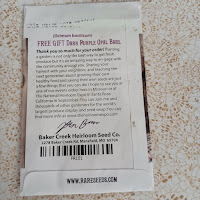
Seed packet for purple opal basil from Baker Creek.
Backstory - in December 2019, I ordered seeds from Baker Creek. In my order they sent a free package of Dark Purple Opal basil seeds. I planted them in the spring of 2020 and they did really well in my garden. I kept saying I was going to make pesto with it, but I didn't own a food processor. I read articles about doing it by hand with a kitchen knife and thought I would give it a try. But I never did.

I planted the basil again this year, and was determined to do more than add the basil to salads and sandwiches. I bought a food processor and within a day was picking basil and making pesto.  

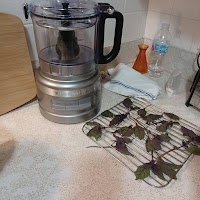
Food processor and basil on a drying rack.

I had more basil than I needed for that batch of pesto, so I put them on a rack to slowly air dry in my oven. 

My basil plant is still producing and I plan to make more pesto, both to eat fresh and to freeze for eating later.  I have planted more seeds and am letting some go to seed to learn if I can keep some going through the winter. 

What is really exciting about this having something else to put on my pasta. I had trouble with acid reflex a few years ago, and one thing I did to help control it was eliminate tomato-based pasta sauces. Since then, I've eaten pasta with a splash of olive oil and some cheese. It is good that way, but I got tired of only that. This summer I started taking fresh tomatoes, bell peppers and some greens from my garden, sautéed them in some olive oil and tossed with pasta and parmesan cheese. And now, I can make pesto and use that as well!

Making the Pesto

I'm reading The Homemade Pantry: 101 Foods You Can Stop Buying and Start Making by Alana Chernila and adapted her recipe. Here's what I did:

Chopped 1/2 cup walnuts in the food processor. 

Added in 1 teaspoon lemon juice and 2 cups packed, fresh basil leaves roughly chopped

Processed until basil leaves were finely minced. 

Sprinkled in garlic powder (fresh garlic can be another trigger to my reflux) and 1/2 teaspoon salt, then turned on processor and poured in 1/2 cup olive oil and processed for a few more seconds. (Basically, I ran it until it looked like I wanted it to.)


Using and Storing the Pesto

Basil pesto in a plastic bowl with a spoon.

I ate some as a dip with crackers, then put the rest in a container, covered with olive oil, and stored in fridge. You can add in grated parmesan cheese when you eat it. You can also put in freezer (without cheese) and store for up to 6 months.

Once the basil in the oven is dry, I'm going to crumble it up and use in recipes as needed.

12 September 2021

Plant Information Sheet

Keep growing information about the plants in your garden with this handy Plant Information Sheet.

Plant Information Sheet

As I learn more about what will grow in my zone, I kept finding myself writing down bits of information I found. It may be from a seed packet or from an internet search, but I needed to find a way to keep it all together so I had it when I needed it. Several years ago I started a notebook, and took one sheet of paper for each plant. 

At least I had all my notes in one place, but when I needed to find out when to plant something or the length to germination, I had to search through everything. There had to be a better way.

Image of printed pages of the plant information sheet.

This year I created a Plant Information Sheet. On it I can list the type of plant, varieties that are good for my zone, what kind of growing conditions it needs, how to plant, harvest, use, and save seeds from, and any other notes I come across. I even made a section where I can list where I get information so I can refer to it later.

I printed off the sheet and began using it. I soon realized things I needed to add or move around to make it more effective, so I edited the sheet. Used it again and made more edits. Yes, this will be a work in progress for a while, but it is so nice to have.

Get Your Copy of the Plant Information Sheet

And I want to share it with you! You can download the Plant Information Sheet and try it out for your records. It comes in .doc format, so you can edit it to make it work better for you. 

How to Use the Plant Information Sheet

Here's a look at the Plant Information Sheet.


Yes, this is completely free. There is no charge and no newsletter sign-up to get it (at least for now). Share it with your friends and other gardeners you know.

If you have suggestions, please leave them in the comments. As I said, this is a work in progress, so suggestions from others are appreciated.

22 August 2021

Homegrown and Homemade - August 18, 2021

 Here is a triumph for this week:

Bowl with homegrown salad

That is a salad I made to go with my dinner one night. And is all homegrown.

For the salad I picked New Zealand spinach, basil, purslane, celery leaves and stalks (regrown), lemon balm, chives, and bell peppers.

For the dressing, it was homemade with ingredients I bought at the store: olive oil, apple cider vinegar, peppercorns and mustard I made from mustard seeds and vinegar.

Compared to what many people produce from their garden this may not seem like much, but I am pleased that I can put together part of my meal from what I grew in my urban container garden. 

And a confession - this was not the best salad I have ever eaten. I think a different mix of greens (some lettuce would have been nice) or a different dressing would have made it better. But it filled me up and I am proud of being able to grow some of the food I eat.

13 August 2021

Recent Harvests from the Container Garden - Pineapple, Bell Peppers, Sweet Potatoes

 July and August in Florida are hot and humid. It is the off-season for growing your own food, but there are still some things producing.

One of my challenges is learning what will grow through this time. Having them in containers means I can move them around, trying to find a bit more shade and relief from the mid-day sun.

The tomatoes are definitely finished, but I am trying to keep the plants going. I am getting a few blooms, but according to a fellow at the farmer's market, they won't set until nighttime temps fall to around 70 degrees F./21 degrees C. I hope I can keep the plants in good shape so once the temps do fall, they will bloom and set the fruit.

One happy surprise this year has been the pineapples. What I have always heard, and have experienced, is it takes two years for a new pineapple plant to produce a pineapple. We had three pineapples last year, and I replanted the tops. I was surprised when in February, I noticed two of the plants setting a fruit! One of them ripened at the end of July and I harvested it.

Red colander with homegrown pineapple and orange bell peppers in it.

I cannot begin to tell you how good it was. The second one is smaller, and still hasn't ripened, so we have something to look forward to. Since the 3rd plant didn't set fruit this year, I hope it does in 2022. It would be nice to have at least one homegrown pineapple every year instead of every other year.

The bell peppers have really produced well this year. They are not very large, but I've harvested at least 2 or 3 every week for over a month. They start out a light green, then gradually turn yellow, then orange, then red. The package recommends picking when they are orange. Those that have gone to red have a little heat to them, which isn't bad. The variety is Garden Sunshine and I bought the seeds from Seed Savers in late 2019.

Here's is another bell pepper harvest, and a few small sweet potatoes.

Orange bell peppers and small sweet potatoes.

The sweet potatoes are pitiful, aren't they? However, I am thrilled. I had a sweet potato sprout in my pantry last fall, so I stuck it in a pot of dirt. It grew slips, which I pulled off and put in another container. I had 4 or 5 in there, which really was too many, but I was experimenting, to see if it worked.

I finally decided to pull some and see what was happening, and this is the result. The one on the bottom is a half-way decent size. I left two of the plants in there in the hopes that additional room will give any other sweet potatoes the space they need to grow a bit. These I harvested are currently curing and then I'll peel and cook them.

One of my best harvests this summer has been the leaves from the sweet potato plants. I got some from the plants in containers, and some from the slips I put in the ground. Here's how they look:

Sweet potato vines and leaves growing in the ground.

I wash and remove the leaves from the stem, then chop and sauté in some avocado or olive oil. Spaghetti sauce flares up my GERD, so this summer I've been adding fresh bell peppers, green onions and fresh herbs to the sweet potato leaves, then tossing it with pasta and some parmesan cheese. It is good and I love that much of my meal comes from my small urban garden.

What are you harvesting from your garden right now?

08 August 2021

Hurricane Preparation Checklist

 Living in Florida I have learned that we have a season I wasn't used to - hurricane season.

Running June 1st through November 30th, hurricane season is the time of year when the waters in the Atlantic Ocean are warm enough to begin forming hurricanes. 

I have also learned that hurricanes approaching give you plenty of days to watch the weather and worry whether or not it is going to hit near me. It is also a time to get prepared.


The first two years I lived here, there was little tropical activity that was near us. Then in October 2016, Hurricane Matthew swept up the Atlantic side of Florida, and I quickly learned how much there is to get ready.

My husband has lived here for over 20 years, so he understood what had to be done. As he ran through the list of things we needed to do, I began writing them down. After the hurricane passed and we cleaned up the yard, I sat down and added to the list everything I could remember. The list was typed up and the next September, when Hurricane Irma came straight up through Florida, I printed off the list and worked through each item.

Each time I pull out the list and use it, I make changes to the list. Some things get added while others that no longer apply get deleted. 

Preparing for an approaching hurricane is a busy and stressful time. Having the checklist to refer to means I don't have to try to remember what needs to be done.

What about you? If you don't live in a hurricane zone, is there a weather event you routinely need to prepare for? Maybe a checklist will help you as well.

Watch the video and think about how you can apply a checklist to your situation. If you have any questions or comments, please leave them below or at the video.


28 July 2021

What Should I Plant Next - June 2021

 I got a late start on my garden this year. For a variety of reasons, I didn't really begin planting until May.

And in Zone 9b in Florida, that is really late. By the end of June it is usually too hot and too humid for much to grow and produce.

There are a few things that do well. Peppers are one of them, and I have had good luck with sweet peppers every year I have planted them.

I got out my garden journal and my seeds and looked to see what I might still be able to plant for the summer, then consider what would be better to wait until August/September to plant for the fall.


How is your garden growing?